 Ano
Ano
Guide · The process
How Anodizing Works, Start to Finish
Anodizing is not a coating that gets applied to aluminum. It is a controlled conversion of the aluminum's own surface into a hard oxide, grown out of the metal by passing current through an acid bath. That distinction explains almost everything else about it.
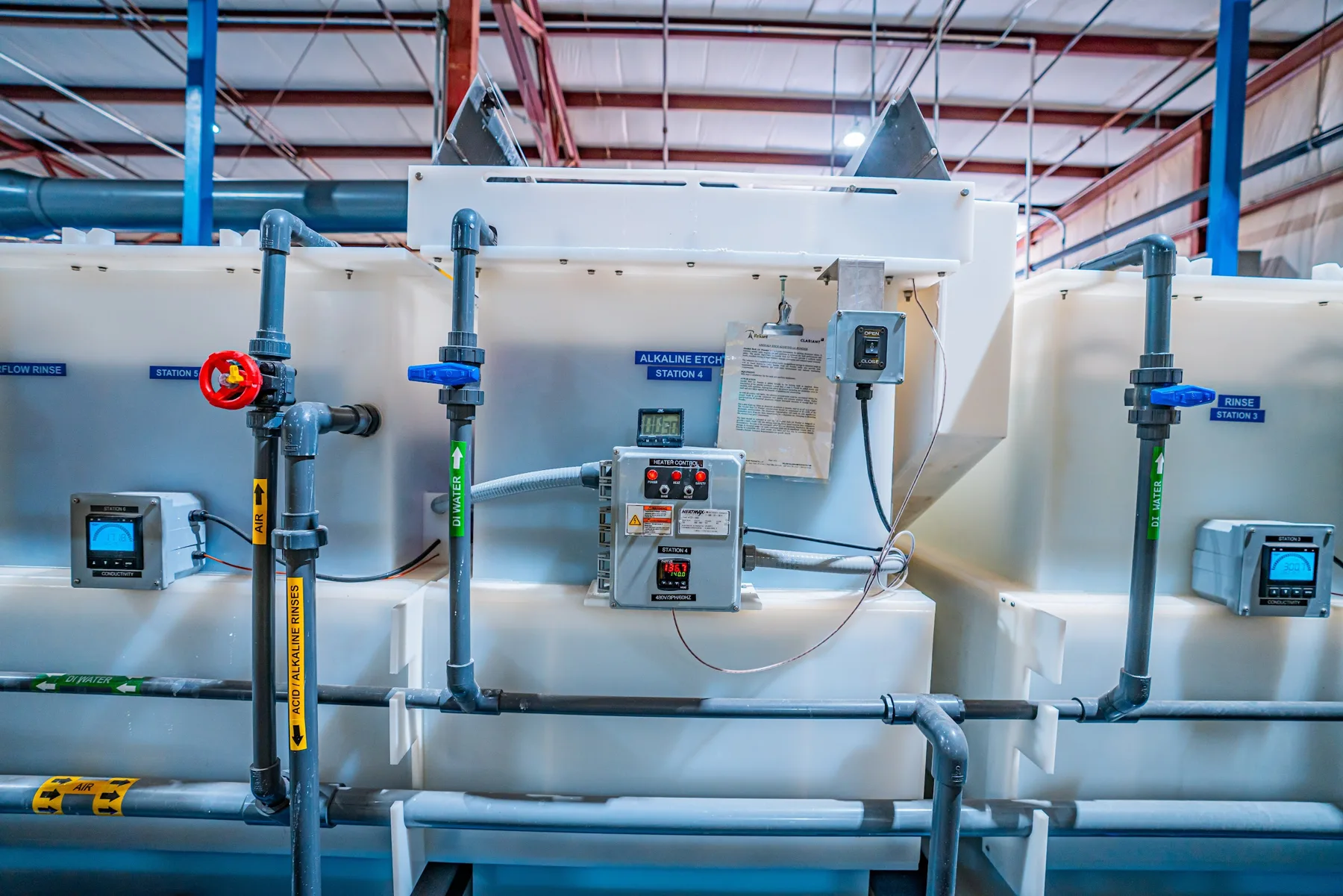 PROCESS CONTROL · THE LINE
What Anodizing Actually Is
Bare aluminum already carries a thin oxide layer. It forms on its own within seconds of the metal meeting air, and it is the reason aluminum does not rust away the way untreated steel does. That natural layer is only a few nanometers thick and it offers very little protection against wear or sustained corrosion.
Anodizing takes that natural process and drives it, hard. The part is submerged in an acid electrolyte and made the anode in an electrical circuit, which is where the name comes from. Current pulls oxygen to the aluminum surface, and the surface converts to aluminum oxide in a structure of dense columns growing perpendicular to the metal.
The critical consequence is that the finished layer is not sitting on the part. It is the part, chemically bonded because it was grown from the substrate. There is no adhesion to fail, nothing to peel at an edge, and nothing that can be chipped off by an impact that the base metal survives. That single property is why Anodizing behaves so differently from the film finishes we do not run, paint and powder coating among them, and it is worth understanding before you compare quotes.
The Six Steps a Part Goes Through
Every Anodizing line runs some version of the same sequence. Ours in Paoli runs it on machined aluminum only, which is a deliberate limit that keeps the chemistry and the results consistent.
1. Racking. Parts are hung on titanium or aluminum racks that carry current into every one of them. This step decides more about the finished quality than anything downstream, and it is the one most people underestimate. Current has to reach every surface, solution has to drain off every feature, and the rack contact point will not be coated, so it has to sit somewhere the drawing tolerates. A part racked badly comes out with soft spots, burn marks, or a witness mark in the wrong place.
2. Cleaning and etching. Oils, machining coolant, fingerprints and handling residue all have to come off, because the oxide grows from the metal and cannot grow evenly through contamination. A light etch follows, which removes a small amount of surface material and gives the characteristic soft matte look. Etching also removes minor surface imperfections, which is why anodized parts often look better than they did going in.
3. Desmutting. Etching leaves behind alloying elements that did not dissolve, mostly a dark residue of copper, iron, silicon and manganese. Desmut chemistry removes it. Skip or shortcut this and you get a patchy, discolored finish, which is one of the most common defects arriving from a rushed line.
4. The Anodizing tank. The part goes into the acid bath and the current comes on. Time, temperature, acid concentration and current density together determine how thick the coating grows and how hard it ends up. Type II runs warmer and lighter; Type III Hard Coat runs colder and at higher current density, which packs the oxide structure much tighter.
5. Coloring, if the print calls for it. Fresh out of the tank the coating is porous, which is the whole opportunity. Dye is drawn down into those pores and the color ends up inside the coating rather than on it.
6. Sealing. The pores are closed, usually in hot water or a nickel acetate solution. Sealing locks dye in and dramatically improves corrosion resistance. It also slightly reduces surface hardness, which is exactly why Hard Coat parts are sometimes left unsealed.
The Step That Surprises Buyers
Racking. Customers assume the tank does the work and the rack just holds parts. In practice a shop's racking discipline is the single best predictor of whether your batch comes back consistent, and it is the reason the people who rack parts here, Phillip and Shane, are named on our About page rather than treated as anonymous labor.
Why the Coating Grows in Two Directions
This is the part that catches people dimensioning a part for the first time. Because the oxide is converted from the aluminum, roughly half the coating thickness grows into the original surface and roughly half grows outward from it. A part does not simply get bigger by the coating thickness; it gets bigger by about half of it, per surface.
On a Type II coating that difference is usually small enough to ignore on everything except close-tolerance features. On a Type III Hard Coat, which builds far more, it matters on almost anything with a fit. A bore gets tighter on both sides at once, so a hole loses roughly the full coating thickness across its diameter. The thickness and tolerances guide works through the numbers and what to put on the drawing.
Where the Time Actually Goes
Buyers are often surprised that a process whose tank time is measured in minutes and hours takes days to turn around. The answer is that most of the elapsed time is not tank time.
A batch has to be received and checked against the order. It has to be racked, which on a complex part is slow, careful work. Then it runs the tanks: cleaning, etching, desmutting, the Anodizing bath itself, dye if the print calls for it, and sealing. All of that is tank time, and all of it together is measured in hours. After the tanks the batch is unracked, inspected against the print, and packed. Then it waits for the truck.
Layered on top of that is queue. A finishing shop is scheduling many customers through shared tanks, so your parts wait behind work already committed. That is why two shops quoting the same part can give very different lead times: they are describing their backlog, not their process. Ours is 3 to 5 days from the day parts reach our dock, with expedites as fast as same day.
Why the Same Part Can Look Different at Two Shops
Anodizing is a controlled process, not an automated one, and the controls drift. Acid concentration, bath temperature, dissolved aluminum content, current density, immersion time, dye concentration and seal conditions all move over a working week, and every one of them shows up in the finished part.
Temperature is the most visible. A Type II bath run warm produces a softer, more porous coating that dyes deeply and wears poorly. The same bath run cold produces a harder, denser coating that resists dye and reads lighter. Neither is wrong in isolation; both are wrong if your drawing expected the other.
What separates shops in practice is whether the numbers are recorded and held, and whether the recipe from your first order is kept for the reorder. That is not glamorous work and it is most of what consistency actually is.
What the Process Cannot Do
Anodizing will not hide a bad surface. It follows the underlying finish faithfully, so machining marks, scratches, handling dents and inconsistent bead blasting all remain visible, and the etch step tends to make them slightly more visible rather than less. If appearance matters, the surface preparation before the part reaches us matters as much as anything we do.
It also will not make dissimilar alloys match. Two parts of the same assembly cut from different alloys, or from different heats of the same alloy, can come out visibly different in shade. That is metallurgy rather than process control, and the honest answer is to tell your finisher which parts have to match before the job runs, not after.
And it is aluminum only. We anodize machined aluminum parts and nothing else, not steel and not titanium. Different metals need entirely different chemistry, which is why we only anodize machined aluminum.
Common Questions
Is Anodizing a Coating or a Treatment?
It is a conversion treatment, which is why the distinction matters commercially. Nothing is deposited onto the part; the surface of the aluminum itself is converted into aluminum oxide. That is why an anodized finish cannot peel or flake the way a paint or powder film can, and why it does not add thickness the way a coating does.
How Long Does the Anodizing Process Take?
The tank time itself, which covers cleaning, etching, the Anodizing bath, dye and sealing, is typically measured in hours and depends on the coating thickness called out. The turnaround you actually experience is longer because of racking, inspection, packing and the queue of work ahead of your parts. Our standard is 3 to 5 days from the day parts reach our dock, with expedites as fast as same day.
Does Anodizing Make Aluminum Stronger?
It does not change the bulk mechanical properties of the part. What it changes is the surface: hardness, wear resistance and corrosion resistance all improve substantially, and on a Hard Coat the surface becomes harder than most tool steels. The part underneath is exactly as strong as it was.
Why Do Anodized Parts Sometimes Look Different From Each Other?
Usually alloy, temper or surface preparation rather than the Anodizing itself. The coating is transparent and takes on the character of the metal underneath, so a different alloy, a different heat, or a different machining finish will read differently even when the process was identical. Tell us which parts have to match and we will run them together.
What Is the Difference Between Anodizing and Electroplating?
Electroplating deposits a different metal onto the surface from a solution. Anodizing deposits nothing; it converts the surface that is already there. That is why plating can be stripped back to a clean substrate and Anodizing cannot be removed without taking base metal with it.
Can an Anodized Part Be Re-Anodized?
Talk to us before assuming it. Stripping an anodic coating removes base metal along with it, so a dimension-critical part may not survive the round trip. On a non-critical part it is usually straightforward, and we will tell you honestly which one yours is.
Keep Reading
Send a Print and Skip the Theory.
If you already know what your part needs, we quote from the drawing and put the date on the quote.